

The Gnostic Gospels
“…[the powers] of the world, [who oppose us].
We now have been put to shame [in the] worlds, but we are not interested in them when they speak ill of us. We ignore them when they curse us. We stare at them in silence when they treat us shamefully, directly to our face.
They go about their business, and we go about in hunger and thirst, looking to our dwelling place, which we perceive through our lifestyle and our conscious. We do not hang on to created things, but we withdraw from them. Our hearts are set on what truly is, and although we are sick, weak, and in pain, there is great strength hidden within us.” (p. 327)
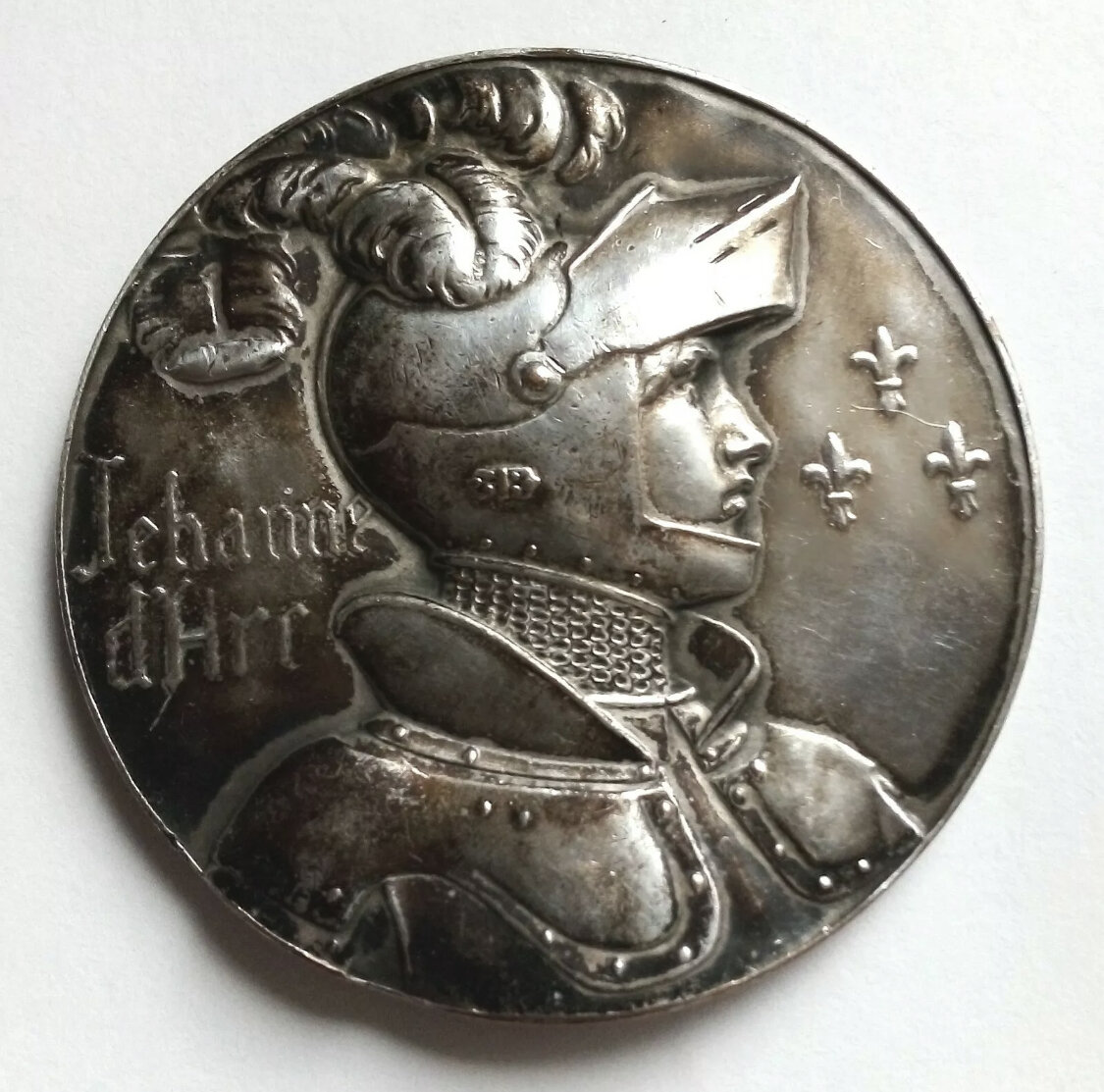
Jehanne d’ Arc
Trial of St. Jehanne translated into English
Jehanne’s signature displaying their preferred spelling
Veneration 30 May
“Asked if she wished to say that she had no judge on earth and whether our Holy Father the Pope were not her judge, she answered: "I will not say anything more. I have a good master, Our Lord, to whom I refer everything, and to none other." (p. 298)
“In respect of what was said of her dress in Articles III and IV, she answered that as for her dress she would willingly take a long dress and a woman's hood and go to Church and receive the sacrament of the Eucharist, as she had formerly said, provided that immediately after her return she might take it off and wear her present dress. And when it was explained to her that she was in no need of wearing this dress, particularly in prison, she said: "When I have done what God sent me to do I will resume woman's dress."
Asked if she thought she was doing well to wear man's dress, she answered: "I refer me to Our Lord." (p. 299)
Feast of St. Jehanne (May 30, 2025)
{pronouns, names, and other gender terminology will be used liberally in this text. many speak on St. Joan’s relationship to women’s liberation movements and histories of queer women. Some idolize her as a symbol of French Nationalism. I will speak about their relationship to Trans People.}
CW: violence against trans people
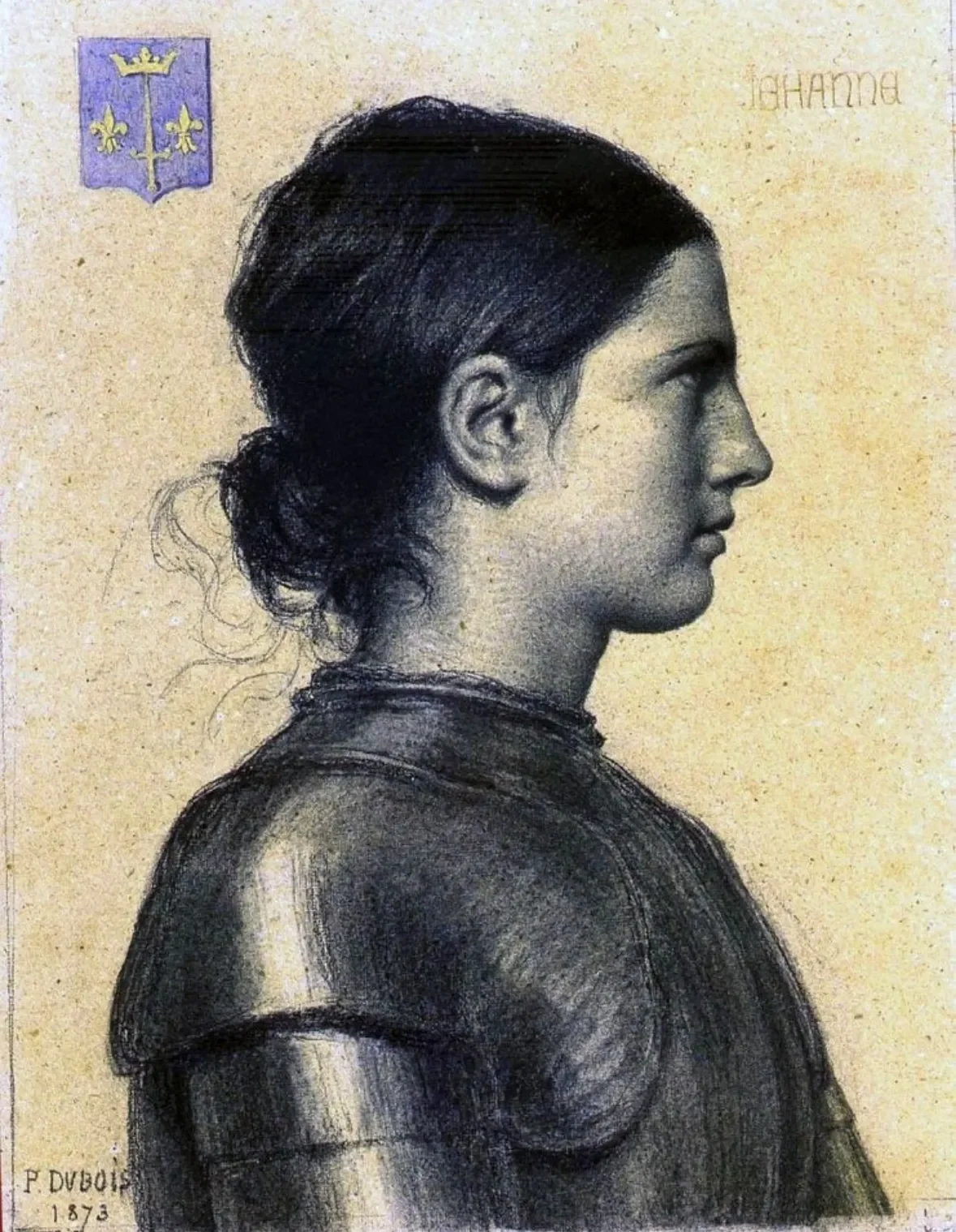
“It has pleased divine Providence that a woman of the name of Jeanne, commonly called The Maid, should be taken and apprehended by famous warriors within the boundaries and limits of our diocese and jurisdiction. The reputation of this woman had already gone forth into many parts: how, wholly forgetful of womanly honestly, and having thrown off the bonds of shame, careless of all the modesty of womankind, she wore with an astonishing and monstrous brazenness, immodest garments belonging to the male sex…” (2) —Trial of Joan of Arc (opening statements)
May 30 is the feast day of Saint Jehanne.
“Jehanne” {ju-ahn} is the name the saint signed on paper, the old French feminized form of Johannes (both deriving from the Hebrew name Yochanan meaning “God is Gracious.”) Other common names for this Saint include Joan of Arc, Jeanne, Joanna, and “The Maid.” With friends and family and with their mother, “Jeannette.”
Saint Jehanne was imprisoned by the English and put on trial in an Ecclesiastical Court in 1430 for being a heretic, for partaking in activities incongruous with their sex, and for “receiving revelations” from Angels and Saints (particularly Michael, St. Catherine (Hekaterinē) and St. Margaret) who she claimed to speak to directly. For these crimes, and others, Jehanne was put to death in the Old Market Square in Rouen on May 30, 1431 - at around age 19.
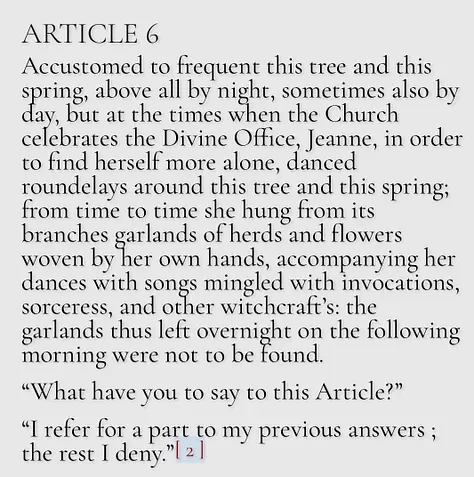
Before their execution, Jehanne was subject to six public examinations, nine private interrogations, and then formerly accused of 70 criminal articles, including multiple instances of witchcraft (carrying a mandrake root believing it would bring good fortune, socializing with the old women in town, dancing at the base of an ancient Fairy Tree during Church services…). The church also didn’t like that she was leading armies, having sex, and learning things from other women (like how to ride horses). Joan also claimed repeatedly that God would forgive their sins, but at this time the Church upheld that no person could know whether they were forgiven on their own, so belief in divine forgiveness and acceptance was heretical in and of itself.
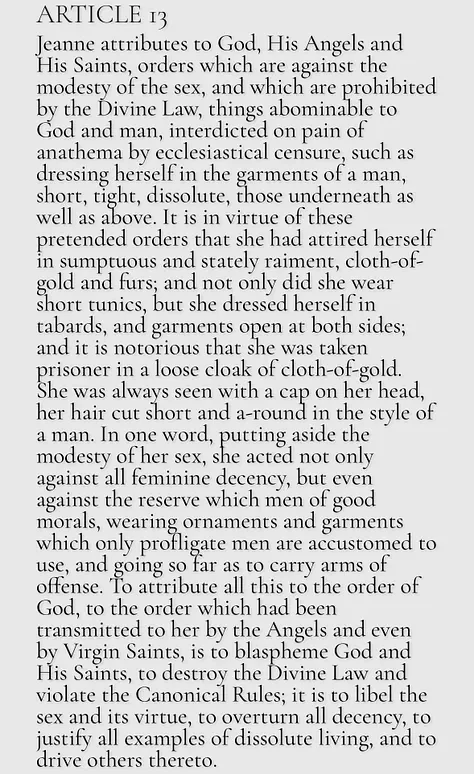
One of the more visible aspects of Jehanne’s disobedience, which occupies 5 full articles of accusation and holds a prominent place in the commentary of the Church officials throughout the trial, was that they wore men’s clothing and refused to take it off, stating that God had commanded them to do so. “those (garments) underneath as well as above” — their chosen non-conformity in this regard is equated throughout the trial to bringing evil out into the world.
“I would rather die than
revoke what I have done
by the order of Our Lord”
Another intriguing accusation by the Church is that Jehanne partook in idolatry allowed himself to be adored by others - another aspect of orthodoxy being that nothing but the One True God is worthy of devotion. That the sacred is entirely non-human (except for Jesus), external to our animal nature, and safe from the arms of Death. Separate from our mortal, embodied experience. Hidden and remote from our own earshot.
This is all false of course. We know this just by being alive.
Idolatry may be a necessary facet of the “Trans spiritual canon.” You know, worshipping something other than God as God? Like believing that coming to know yourself deeply, or coming to know another person deeply, can be akin to knowing a whole universe, a whole divinity? You know, space is mostly empty…and our bodies are mostly empty too. But something takes hold of the matter that is there.
Trans People’s free enactment of their individual beauty and life for the sake of Beauty and Life, their honoring of what they know to be true of themselves, and standing up for their right to exist as they so choose, is made possible by a great fortitude in spirit, and our collective history. It is also made possible by the Laws of Nature, as we are an intrinsically necessary aspect of the world that arises spontaneously out of nothing again and again, like flowers coming in their given season..
“I refer me to God”
There is an inextricable connection between the tender vulnerability of transness, which seeks only to Be, and Nature itself. Neither of us (trans people nor Nature) can seemingly find a good reason within the colonial mindset to excuse our continued existence. If you want to, you can smother out all goodness for a time. You can oil-slick coat it so it can’t fly. You can drain it of any life, crush it down into the smallest of pieces, cut it down to the ground. But birth and death are endless things. The only action that changes anything about anything really seems to be Love, which is a wellspring unending that we need only harness with confidence that we are justified in It.
Joan could have lived.
The trans body the trans person the average abandoner of their sex the impenetrably butch individual the effeminate one, the cult of women who chopped off their breasts in devotion, the Dianic tribes, the transfemme emperor, the ones who self-castrated, the ones who changed sex and name and dress to fight in the Civil War and just stayed that way forever. The trans woman beaten and kicked in the head until she’s seizing up on the restaurant floor. The trans panic defense, usable in court. I always think that Joan is depicted as older than they were.
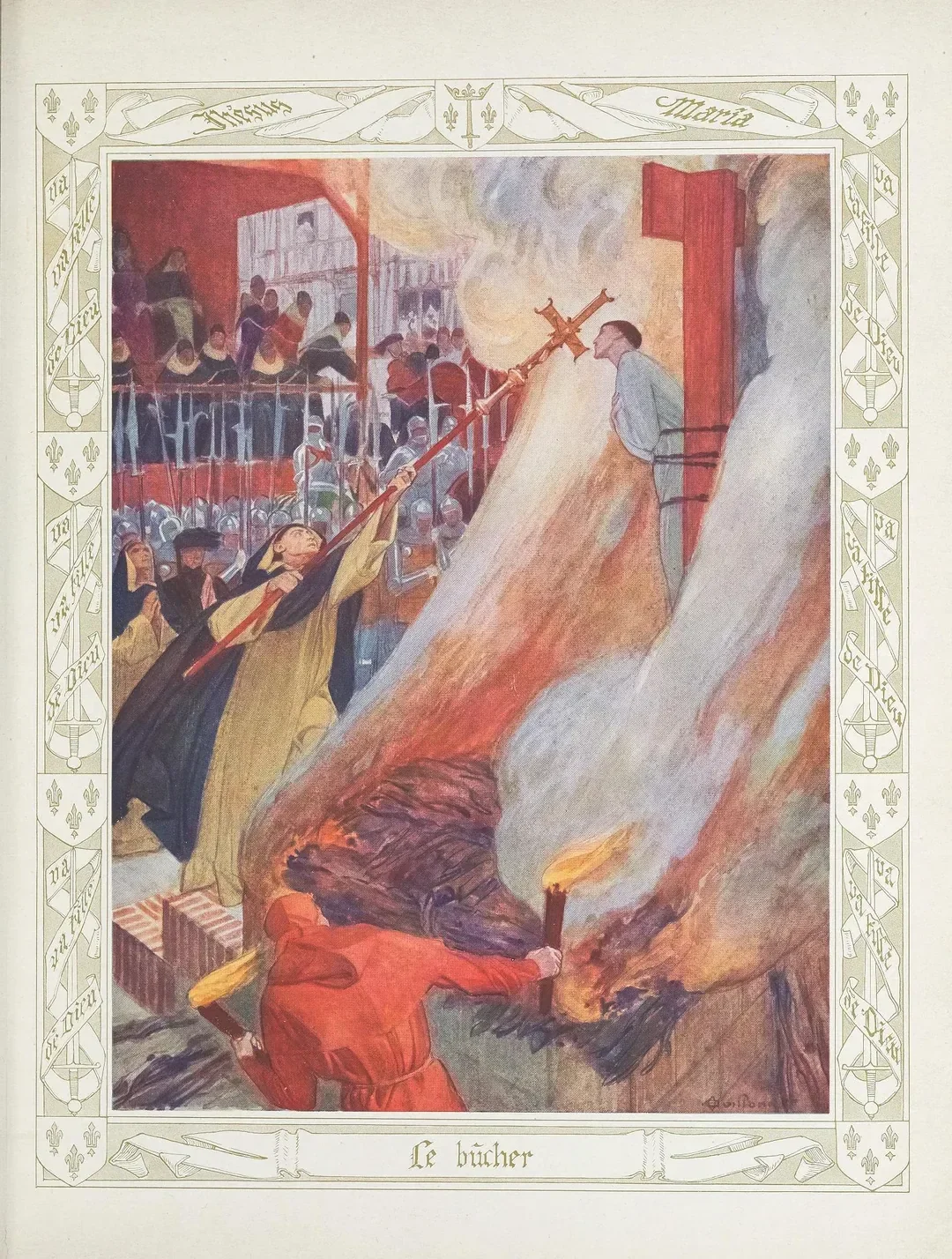
I believe many of us share a pain that they, too, felt, upon witnessing the people of Rouen allowing them be led to the pyre. To be tied to the wooden beam. To burn. I find I am quite different than I used to be. I am no longer able to romanticize Joan’s death. At what cost did they edge-out their eye out that way? To be impenetrable? At what cost did they stand up for justice?
There is no perfect victim. There is no way for the persecuted to present themselves in such a mode as to avoid being consumed alive. Sometimes, there is nothing that can be said. The hand must be held back from the weapon. Protections and actions need to be enacted at the level of a culture or a society or a community in order to stop violence of this nature. Bystander intervention needs to occur. Justice is intrinsically woven into the laws of Love.
You know what I heard? After St. Jehanne died, just moments after, people in the onlooking crowd started to scream and cry. “We killed a saint! We killed a saint!” The public wept.
Maybe the one day the west will scream for Palestine and weep for the dead. Maybe one day, the pang of regret. I hope it occurs before it is too late.
I am reminded of the writing of Sophie Strand on the matter of St. Joan — “She did not court martyrdom and was increasingly frantic as she realized her voices assurance of victory might not conform to the victory she had imagined for herself. When her counsel shifted and Michael the angel of war was exchanged for Gabriel the angel of acceptance and compassion, she spooked, asking the angel, “Will I burn?” She reported that he said to her, “Wait upon him in all your doings.” As she approached her execution, it seems she experienced a radical crisis in the personal faith for which she is so well-loved. I think it is more compassionate to the human being to allow her this personal apostasy” (full piece “No Savior” by Sophie Strand)
There is something deadly tender about connecting to this Saint as a trans person now. There’s something fresh-born and delicate in knowing one another across time. It feels private, like a blood oath between friends. I think of Jehanne in the prison at night. In their room at night, or between battles. It is said that they spoke to Angels and to dead saints but I feel my hand touch something more human in them as well - the fear of death, the longing for companionship and understanding, the wordlessness of seeing oneself as small in relationship to the all the forces of the world.
It is possible that Joan was gender non-conforming at heart, and that the reason they weren’t willing to change into women’s clothing was because they knew they were right.
I think about visiting Domrémy, the place of Jehanne’s birth where the fairy tree once was (perhaps a Hawthorne or some kind of Oak?) or the place of their death. To step into the square where they were murdered like so many others in our community (by burning or stoning or drowning or being left out in the elements or worse). Sometimes I wonder what can be done on the killing grounds to turn the tides.
I used to talk a lot about how part of being Trans is standing on the edge of life and death, where since you come very close to death quite often eventually you find that you’ve lost your fear of it. You were willing to sacrifice many of the things that tethered you to secure, known places after all, in order to pursue your own happiness and liberation. It took faith and trust in your own desires, and that’s the key here. You say “death take me, I have nothing left to lose” because you have already lost everything and you are still here. There is something about you that is endless, and you have such faith in the righteousness of meeting Death, knowing we will all meet it one day, that Death tells you “from this day on, I walk behind you as your friend.”
As mentioned above there is something difficult here to chew on. Something about being willing to settle for early death as a likely outcome for my trans kin. I have not been able to finish writing this until now even though St. Joan’s feast day was a week ago, and it still does not feel complete. Maybe I’ll finish it next year when we feast again.
In the meantime I hope that they will find joy in seeing us live openly in the face of such great misunderstandings.
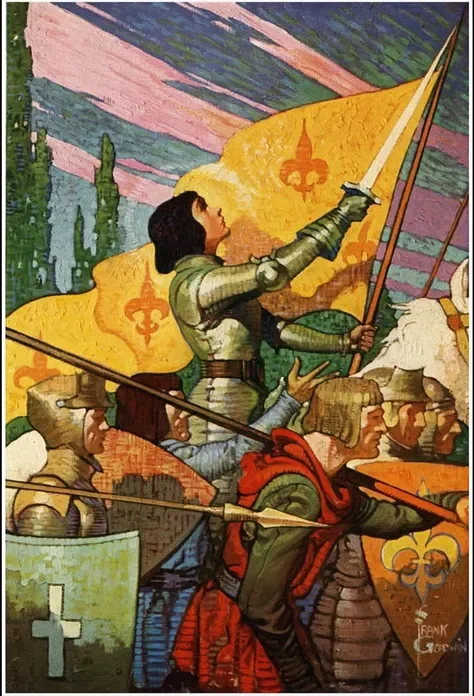
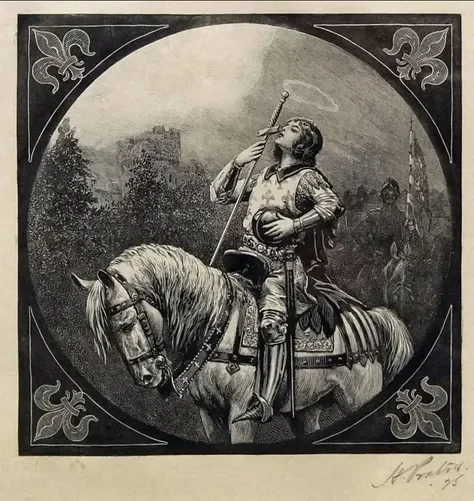
image reference:
Paul Dubois (1873)
From Jeanne d'Arc by Frantz Funck Brentano, Illustrations by O.D. U. Guillonnet (1912)
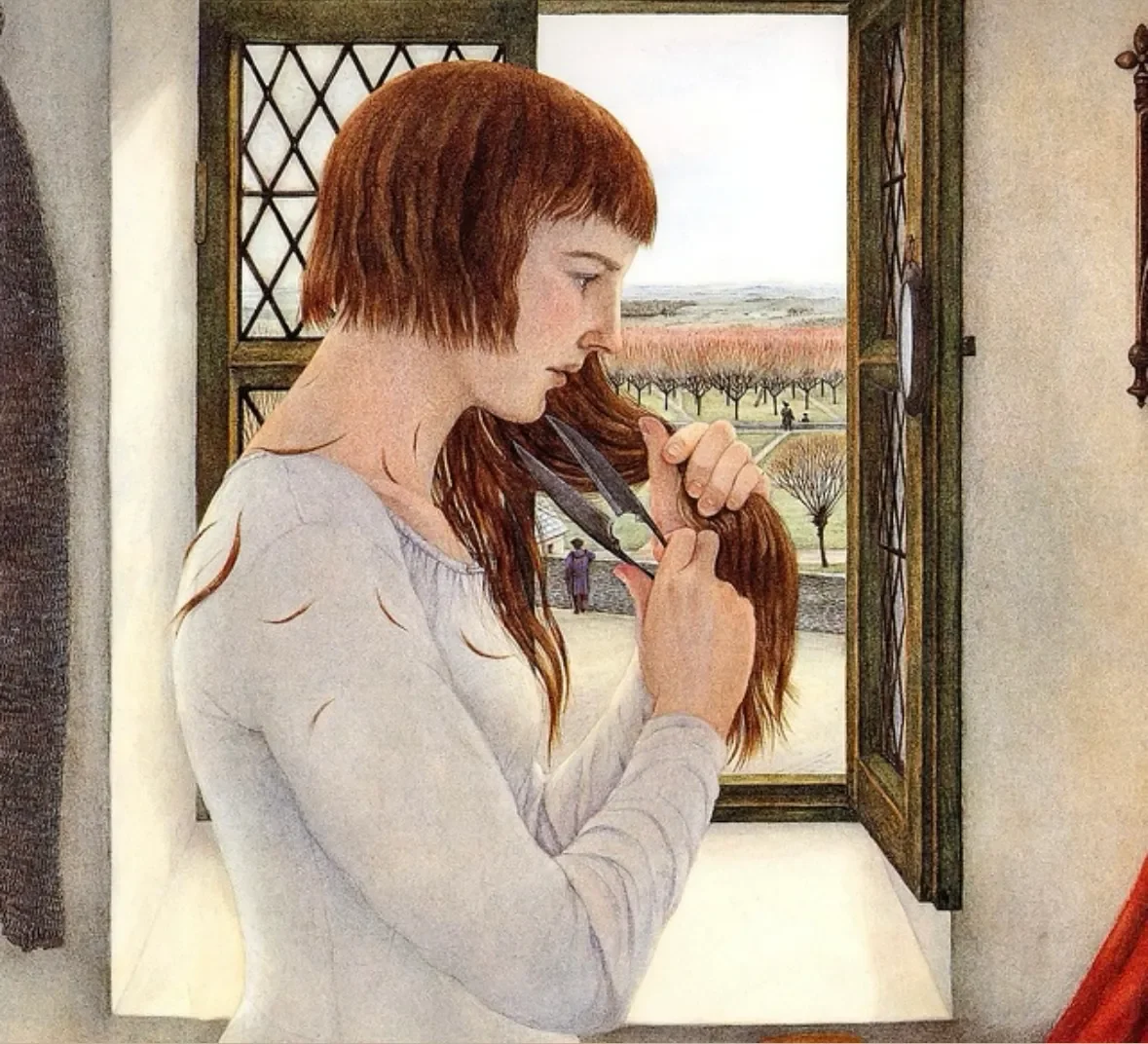
Illustration of Jehanne Cutting Their Hair by Josephine Poole
St. Joan Illustrated, by George Bernard Shaw
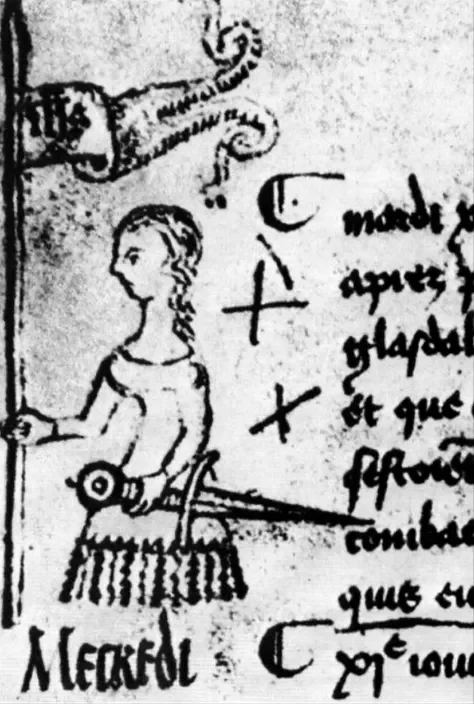
The earliest surviving depiction of St. Joan, a sketch by the secretary of the Parliament of Paris, Clement de Fauquembergue, in the margin of the official register he kept for daily events on May 10, 1429, after Paris received word of Joan's great victory at Orleans. “Since de Fauquembergue had never seen Joan he sketched her based on the reports he had received of a young maid leading the French army carrying a sword and a banner which he emphasized in his sketch.”
6-10. Excerpts from the Trial itself
11. artist unknown
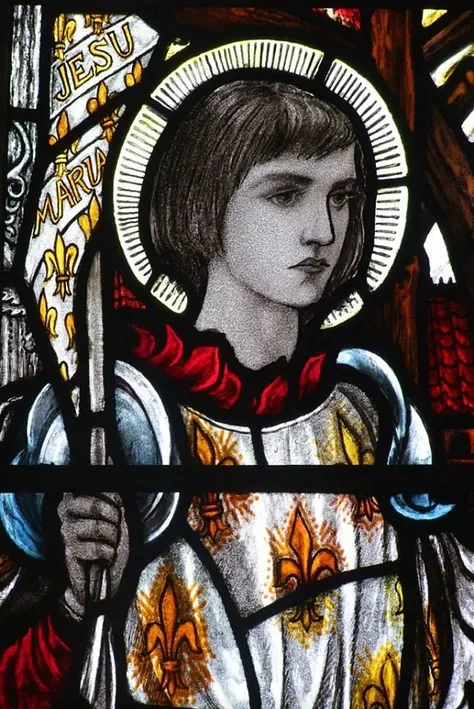
12. Christopher Whall (1922)
Saint Wilgefortis
Veneration 28 Feb.
According to her legend she prayed to be ‘disfigured’ as a woman — to be more in the image of Christ — in order to avoid a forced marriage. God caused her to grow a beard, which made her an unattractive bride.” Her father crucified her. She is the patron saint of abused women, infertile women, and prisoners.
Pan
“Servius tells us...
Pan is a rustic god formed in similitude of nature and so he is called Pan, i.e. All; for he has horns like the rays of the sun and the horns of the moon: his face is ruddy in imitation of the aether: he has a spotted fawn skin on his breast, in likeness of the stars: his lower parts are shaggy, on account of the trees, shrubs, and wild beasts: he has goat’s feet, to denote the stability of the earth: he has a pipe of seven reeds, on account of the harmony of the heavens, in which there are seven sounds: he has a crook, that is a curved staff, on account of the year, which runs backwards on itself, because he is god of all nature. It is fabled by the poets that he struggled with Love (Eros) and was conquered by him because, as we read, love conquers all.”
(p. 28-29 / “Pan: Great God of Nature by Leo Vinci)
Collected Prayers:
“Benedicto: May your trails be crooked, winding, lonesome, dangerous, leading to the most amazing view. May your mountains rise into and above the clouds. May your rivers flow without end, meandering through pastoral valleys tinkling with bells, past temples and castles and poet’s towers into a dark primeval forest where tigers belch and monkeys howl, through miasmal and mysterious swamps and down into a desert of red rock, blue mesas, domes and pinnacles and grottos of endless stone, and down again into a deep vast ancient unknown chasm where bars of sunlight blaze on profiled cliffs, where deer walk across the white sand beaches, where storms come and go as lightning clangs upon the high crags, where something strange and more beautiful and more full of wonder than your deepest dreams waits for you -- beyond that next turning of the canyon walls.”
Edward Abbey
Celtic Blessing
On the day when the weight deadens on your shoulders and you stumble,
May the clay dance to balance you.
And when your eyes freeze behind the grey window, and the ghost of loss gets into you,
May a flock of colors, indigo, red, green, and azure blue come to awaken in you a meadow of delight.
When the canvas phrase and the coroc* of thought and a stain of ocean blackens beneath you,
May there come across the waters a path of yellow moonlight to bring you safely home.
May the nourishment of the earth be yours.
May the clarity of light be yours.
May the fluency of the ocean be yours.
May the protection of the ancestors be yours
And so, may a slow wind work these words of love around you
An invisible cloak to mind your life.
*coroc - a canvas fishing boat used in the west of Ireland
John O’Donohue
“Be merciful to me, Lord, for I am in distress; my eyes grow weak with sorrow, my soul and body with grief” (Psalm 31:9, NIV). My heart is broken, my mind exhausted. I cry out to you and hardly know what to ask. All I can do is tell you how I feel and ask you to “keep track of all my sorrows. . . . [collect] all my tears in your bottle. . . . [and record] each one in your book” as I pour them out to you. Amen. (Psalm 56:8).